The Analysis and Interpretation of Qualitative Data
Part 1: Introduction
Social change is the ability to make a difference in whatever area or field you are in. It does not need to be done on a large scale and it can start with those things around you (Maton, 2008). The result of positive social change is that the people and the environment changes around you for the better (Ellis, 2006). Whereas Walden University’s goal of positive social change involves the development of ethical scholar-practitioners (Walden University, 2015), individuals can do it by way of increasing awareness and understanding in areas that need improvement.
Maton (2008) discusses his pursuit in trying to create positive social change and the role of community psychology in creating positive social change. He identifies four domains in which this can be accomplished, which include empowering adults to overcome personal difficulties, empowering youth who are growing up in adverse circumstances, empowering citizens in impoverished communities to take action to improve where they live, and empower historically oppressed citizens to resist and challenge societal culture and institutions. Whereas the first two domains address empowerment at the individual level, the last two address it at a collective level. He also states that the first two have received more focus within community psychology than the latter.
This study will address social change from the aspect of a student enrolled at Walden University and what social change means to them as an agent of change. Researching social change poses several issues. For instance, the definition of social change differs from person to person. This also means that what I define social change as may be different from the person I am interviewing and this may skew my interpretation of the results. Although Walden University provides an overview of what social change is to them as an institution, how students go about implementing social change may vary.
Part 2: Role of the Researcher
My role in the data collection process for this assignment is as a graduate student and interviewer. There are no ethical issues that I am aware of that could arise during the data collection process. Any issues of power differentials or conflicts of interests are non-issues since the person I interviewed is not in this class and is currently enrolled as a graduate student at Walden University as well. Therefore, I view the person as a peer rather than a classmate. My role is to record the data in a fashion that is unbiased and use my knowledge to the best of my ability to interpret what the interviewee is saying, so that I may capture the meaning of their words and use them for research purposes.
Part 3: Results
Scholar of Change Video 1:
Date: 1/1/2017
Time of Viewing: 2:10 AM
Duration: 3 minutes
Your Physical Setting: In my home office
How data was recorded: Microsoft Word
Name of Video: Benjamin Isaac, EdD student, inspiring children with special needs
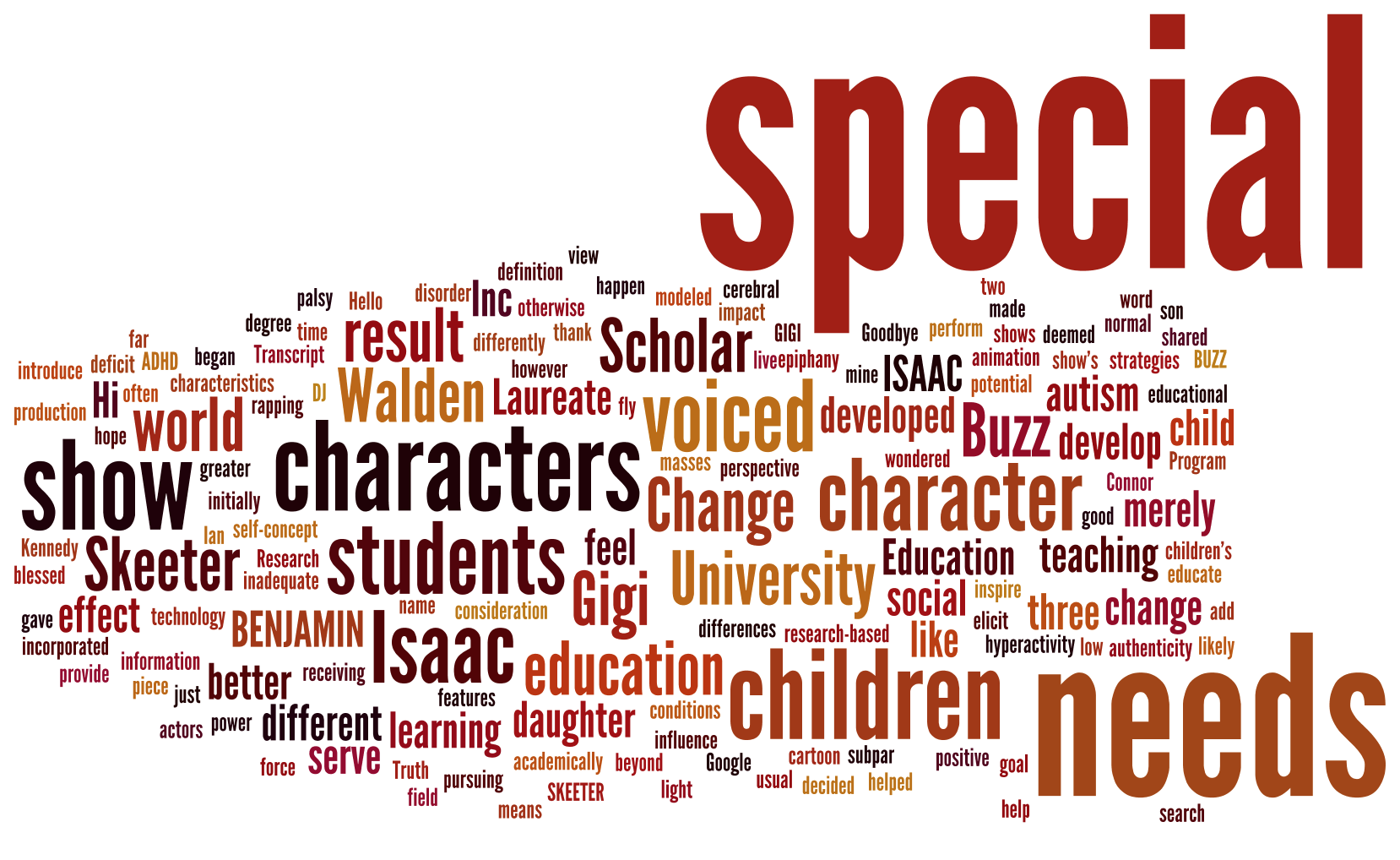
I selected the Scholar of Change video featuring Benjamin Isaac who is a Walden University student pursuing a doctoral degree in the field of special education. Benjamin hopes to provide a positive impact on how others view children with special needs. In this Scholars of Change video, Benjamin has a deep connection to the issue that may be related to his daughter having cerebral palsy. He wishes not only for special needs children to be looked upon favorably and not as being inadequate. Benjamin spends quite a bit of time during the video trying to show that special needs kids can do things just like other kids. Therefore, he modeled his cartoon characters from special needs children and had them to voice them as well. He also talks about how special needs children are not just their disability. Therefore, he hopes to change the view of special needs children in the sense that they are not handicapped, but they blessed and deserving of good and equal treatment.
| Transcript | 1^(st) Cycle | 2^(nd) Cycle |
|---|---|---|
| My name is Benjamin Isaac and I'm currently a Walden University student pursuing a doctorate degree in the field of special education. | Higher education | Education |
| Research shows that students with special learning needs who feel good about themselves perform better academically than those with low self-concept. | Special learning needs | Disability |
| A Google search for the definition of the word special reveals an adjective that means better, greater, or otherwise different from what is usual. But far too often, students deemed special are made to feel like they are inadequate, subpar, and unintelligent. That's why I am attempting to effect social change with the help of a few very special friends of mine. I'd like to introduce you to Skeeter Buzz, and Gigi. | Inadequate, subpar, unintelligent | Self-esteem |
| These three characters were initially created for an educational children's cartoon that features live child actors mixed with 3D animation. As the characters began to develop, however, I had an epiphany. I wondered what would happen if I gave all three characters special needs. And what if these special needs were depicted as merely mental and physical conditions and not definitive characteristics of who these characters were. | Special needs | Disability |
| As a result, Skeeter was developed as a character with autism. Buzz, the rapping fly, was further developed as a character with attention deficit hyperactivity disorder, or ADHD. And Gigi was modeled after my own daughter, who has cerebral palsy. | Use children with special needs as the characters | Capable |
| To add authenticity to each character, I decided to have each character voiced by a child that had that same condition. As a result, Skeeter, the DJ, was voiced by Ian and Connor, two children with autism. Buzz was voiced by my son Truth, and Gigi was voiced by my daughter, Kennedy. | Autism voiced by son | Capable |
| The purpose of the show was not to elicit sympathy from the masses, but to show children with special needs in a very normal light. As a result, the special needs will more than likely only be mentioned in the opening credits. After that the children will merely be who they are. | Children with special needs should be seen in a normal light | Ordinary |
| The education I am receiving from Walden University will serve to provide research-based teaching strategies and information about students with special learning needs that will be incorporated into the show's production and shared with the viewers. | Special learning needs | Disability |
| Through this show, I intend to leverage the power of teaching in technology and effect positive social change through education. It is my hope that the characters will serve to inspire, influence, and impact all children with special needs. But beyond that it is my goal to show the world that students with special needs are just that, special, blessed with differences that force them to interact with the world differently because they view it from a different perspective. | Positive social change through education | Social Change |
| Walden University has helped me develop this show into an entertaining piece of media with the potential to educate the world about the true nature of children with special needs. We thank you for your time and consideration. | Special needs are misrepresented | Social Change |
Scholar of Change Video 2:
Date: 1/5/2017
Time of Viewing: 3:40 AM
Duration: 2 minutes
Your Physical Setting: In my home office
How data was recorded: Microsoft Word
Name of Video: Battling drug addiction in the heartland
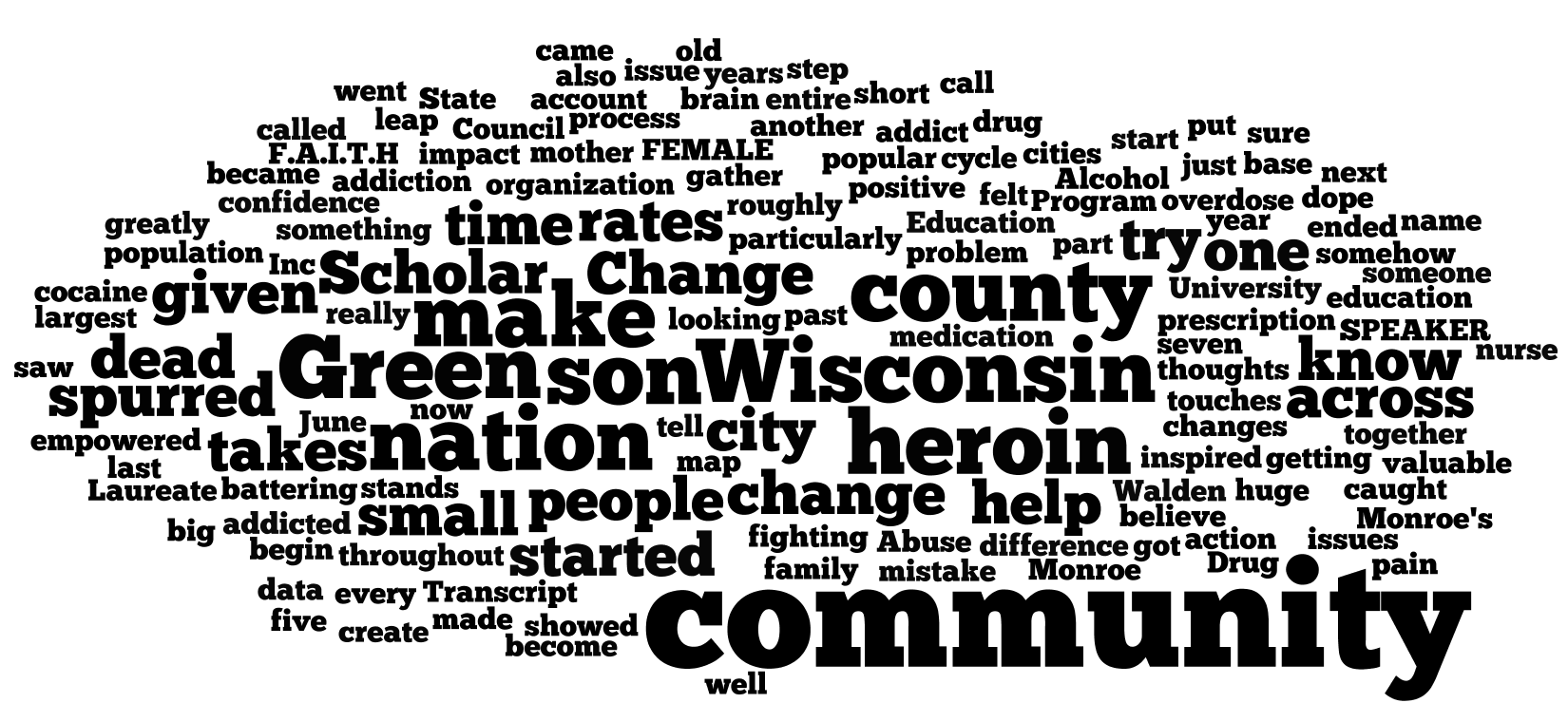
I selected the Scholar of Change video featuring Jackie Kundert. Kundert is a mother and a nurse who wishes to address the issue of drug overdose. She has a son who became involved with heroin but was also surprised by the drug overdose rates in her own county in Wisconsin. Thus, she started an organization to help fight addiction. Descriptive coding summarizes short phrases and it is meant to identify the topic and not abbreviations of the content (Saldaña, 2016).
The concept of addiction is common in both passages in one way or another. In the first, Kundert mentions how her son became an addict. Prior, she mentions that the issues around addiction have increased. In the second passage, addiction plays another key role but she focuses more on help from others as opposed to the addiction itself.
| Transcript | 1^(st) Cycle | 2^(nd) Cycle |
|---|---|---|
| JACKIE KUNDERT: My name is Jackie Kundert. I'm a mother and a nurse from Monroe, Wisconsin, which is part of Green county. Monroe's population is roughly 10,000 people. And it's the largest city in Green county. | ||
| During the past five to seven years the issues of drug overdose have become popular throughout the nation. What once was a big city problem is now felt in small cities across the nation. This issue touches me greatly as I have a son who got caught up in the cycle. My son ended up on prescription pain medication, which he became very addicted to. And from there it was a short leap for him to start heroin. | drug addiction is a problem | addiction |
| What really spurred me on to try and make a difference was looking at a Wisconsin State Council of Alcohol and Drug Abuse map that showed the heroin rates in Wisconsin, but particularly, for me, in Green county. When I saw those rates it spurred something in me that made me know that I had to somehow try and make a positive impact on this community. | Make a difference, positive impact | Social change |
| FEMALE SPEAKER: My son came to us when he was one year old. He started out with dope, but then he went to cocaine. So then the next step for most people is heroin. | Drugs | addiction |
| The last time I'm not sure if it was another call for help or if it was just a mistake. I could tell that he was dead, you know, that he was brain dead. | ||
| JACKIE KUNDERT: In June, 2015 I started an organization called F.A.I.T.H., which stands for fighting addiction it takes help. And I believe it takes help not only from the addict, but also their family as well as a community. | fighting drug addiction takes many people | addiction |
| My time at Walden University has given me the confidence to put my thoughts for battering this community into action. It has given me a base to gather data, and empowered me to begin the process of getting valuable education to the entire community. If someone could be inspired in every community across the nation to create change, together all of our small changes would make one huge change. | confidence | Self-esteem |
Interview:
Date: 1/31/2017
Time of Interview: 1:30 AM
Duration: 5 minutes
How data was recorded: Google Voice
Your Physical Setting: In my home office
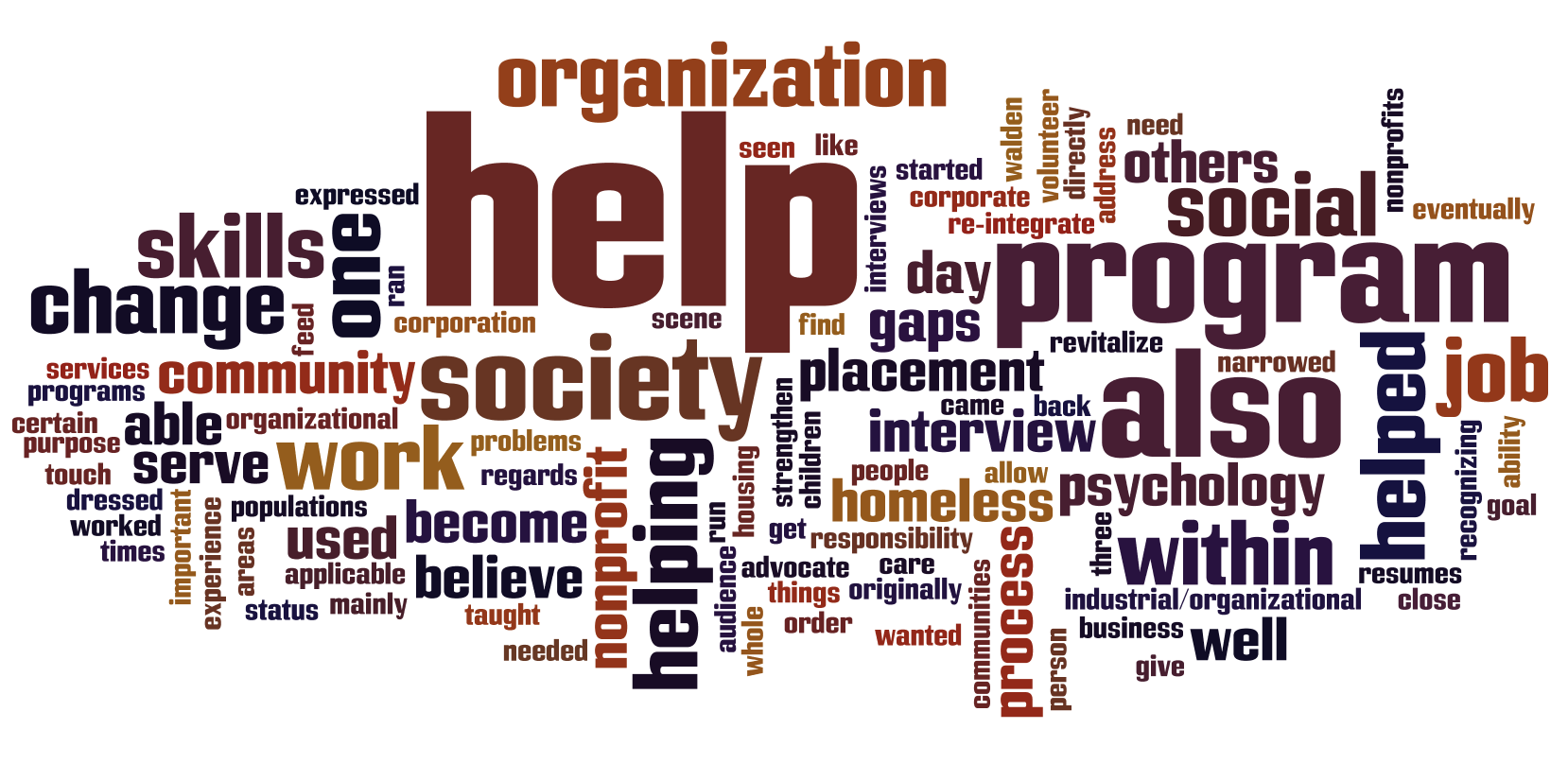
In my phone interview, my participant spoke about what social change means to her, her role in social change, and how she continues to be a social change agent. I followed up with her afterwards, and although she mentioned that she started in 2016, she started her undergrad at Walden University in 2013 and completed it in 2016. My participant mentioned that she started one program of study at Walden but changed because she wanted to do more work with nonprofits. Helping others is important to her and is a theme throughout the interview.
| Transcript | 1^(st) Cycle | 2^(nd) Cycle |
|---|---|---|
| Interviewer: | ||
| Hi. Thank you very much for helping me practice my interview skills. As you know, this purpose of this interview is to talk about what social change means to you as a Walden student. This should last about 10 minutes. After the interview, I will be examining your answers to practice data analysis. And some of your answers will be shared with my instructor and classmates. However, I will not identify you in my documents and no one will be able to identify you with your answers. You can choose to stop this interview at any time. Also, I need to let you know that this interview will be recorded for transcription purposes. Do you have any questions? | - | - |
| Interviewee: No, I do not. | - | - |
| Interviewer: Are you ready to begin? | - | - |
| Interviewee: Yes, I am. | - | - |
| Interviewer: Can you tell me what program you are in at Walden University? | - | |
| Interviewee: I am in the Doctoral Industrial/Organizational Psychology program at Walden. | Doctoral student | Student |
| Interviewer: And what year did you start? | - | - |
| Interviewee: I started in 2016. | - | - |
| Interviewer: Was working for Social Change important for you before you came to Walden? | ||
| Interviewee: Yes, it was. | Affirmation | Social change |
| Interviewer: Can you give me an example of what you did? | - | - |
| Interviewee: I used to volunteer with a program that worked directly with the homeless. And its whole goal was to help the homeless, not only to feed them three times a day, but also to help them with job placement skills, helping them find housing, day care for their children, and other things like that to help them to re-integrate back into society. | help the homeless | altruism |
| Interviewer: Was the Social Change mission important to you in making your choice to come to Walden? | ||
| Interviewee: It was. Originally, when I came to Walden, I started out in Business Management, mainly because of the nonprofit organization scene where I live. And I wanted to get more experience on how to run a nonprofit but also how to help other nonprofits to strengthen their ability to serve their populations. Eventually, I wound up in Psychology. And then I narrowed down to Industrial/Organizational Psychology to allow me to help organizations to work on their Corporate Responsibility with regards to how their work with the communities that they touch, not only the organizational community within their corporation, but also the community of the audience that they serve. | Affirmation Non-profit Community focused | Social change Non-profit Social change |
| Interviewer: From your perspective, what is Social Change? | ||
| Interviewee: I believe Social Change is the process of recognizing various fault lines or gaps within certain areas in society and working to close those gaps, to address those problems, with the expressed purpose of bettering the society for those who need those services and to help them to be able to help others as well. | process of recognizing various fault lines or gaps within certain areas in society and working to close those gaps, to address those problems | Social change |
| Interviewer: Can you give me some examples of what you mean by that? | ||
| Interviewee: Well, one program that I really enjoyed helping with, with the organization that I used to work with, was the job placement program. Because not only was it just simply a program to help people be seen in interviews, but it also helped them to revitalize their resumes, to give them job skills that they needed in order become employable. It helped them with the interview process, it helped them with the way that they dressed for the interview. So, those types of skills, in itself, are applicable to helping someone become an advocate for Social Change. And I believe that that program was one of the most important programs that the organization ran because it taught one person to be able to change their social status within society, but also to help others to do the same. | Helping help | Altruism, social change Altruism, social change |
| Interviewer: Thank you for your answers. Do you have anything else you'd like to share? | - | - |
| Interviewee: No, I do not. | - | - |
| Interviewer: Do you have any questions for me? | - | - |
| Interviewee: No, I do not. | - | - |
Resources from the Walden social change website:
Date: 2/4/2017
Time of viewing: 1:00 AM
Duration: 20 minutes
How data was recorded: Microsoft Word
Your Physical Setting: In my home office
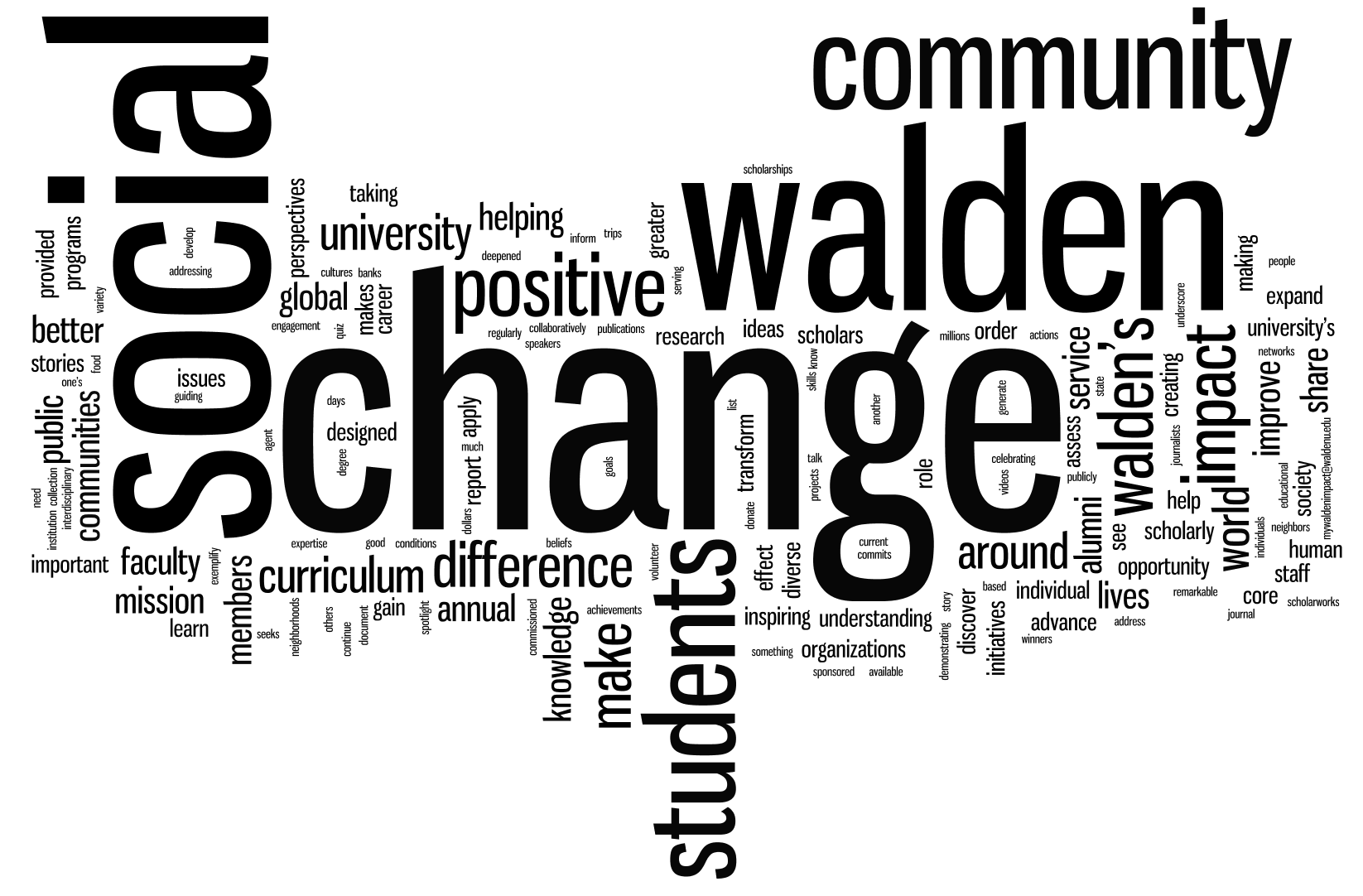
Walden University’s website on social change discusses the importance of social change and how it is integral even in the curriculum. Walden has a history of social change, and the students and faculty affect it on a global scale. There are two main events that Walden sponsors for social change. The first is Global Days of Service, in which the university encourages faculty and students to change the world around them by helping the community in which they live by donating their time and expertise. The second is through the Scholars of Change video contest. The contest encourages students to share their stories about how a degree from Walden University will assist them in impacting social change.
[TABLE]
Part 4: Trustworthiness and Summary
The theme that is common between all the sources is helping others and the community that we live in. When I refer to community, this could be on a global scale or local scale. With each source, there is a target audience that they wish to benefit. With the first scholar of change video, it is people with special needs. With the second scholar of change video, it is people with drug additions. The interviewee in the phone interview mentioned helping the homeless. The only source that does not specify a target is Walden University. On Walden’s website about social change, they mention helping the greater good. It is very general.
There are four things that help ensure trustworthiness in qualitative research. These are whether the research findings are credible, transferable, conformable, and dependable. Credibility is described by how confident the researcher is in the certainty of the research study’s results. Transferability refers to how the qualitative researcher establishes that the research study’s findings are applicable to other settings. The degree of neutrality in the research study’s findings is conformability. Lastly, the extent that the study could be repeated by other researchers and that the findings would be consistent is dependability.
Shenton (2004) lists strategies that include triangulation and member checks to improve credibility which shows that a study’s findings are credible. Triangulation is achieved by asking the same research question to other participants. Member checks are done by the researcher asking the participants to review both the data collected and the interpretation of the data by the researcher. Using purposive sampling, a researcher can address issues of transferability. Purposive sampling is synonymous with judgmental, selective, or subjective sampling. It is a random approach used to address concerns of bias. Issues of confirmability can be addressed by providing an audit trail (Lietz, Langer, & Furman, 2016; Morse, Barrett, Mayan, Olson, & Spiers, 2016). Doing this will highlight the analysis of the data each step of the way. Finally, the research study should be replicable and the findings consistent (Williams & Morrow, 2009). This will make the study dependable. An inquiry audit can assist in establishing dependability.
I was able to address the trustworthiness of my findings by first addressing credibility. I checked with the participant and sent her a copy of the transcript and my findings to make sure I did not misinterpret anything and I also asked her if there was anything that she would like to clarify. The questions are general and could be asked of any university student and not just students attending Walden University. Therefore, the study would be transferrable and conformable. The general definition of what social change means does not differ and asking someone else at Walden University would more than like provide similar results if asked by a different researcher. As such, I feel that the research study is dependable.
To the Walden graduate, social change is the transformation of institutions and culture over time by way of using their knowledge to affect that change positively. My understanding of what it means to be an agent of positive social change has not changed. Before starting at Walden University, I held the belief that it is every individual’s duty to be the change that they seek. I was raised with the view that as you grow up and you become successful, reach back and help others. I was a product of someone reaching back and helping me and my family from the time I was little until the time I first attended college. Had it not been for the help of others, I doubt I would be in the position that I am in now.
The article that best aligns with my interests regarding social change is “Transforming “apathy into movement”: The role of prosocial emotions in motivating action for social change” (Thomas, McGarty, & Mavor, 2009). Social change should be a part of our social identities. However, the people do not always engage in social change. Prosocial behavior is beneficial (McMahon et al., 2012). And emotion as a social change agent could work. It has been instrumental in our history from voting rights, to ending slavery, to how we treat immigrants and those are suffering from the effects of war. Images of those events have been very powerful.
**\
References
- Ellis, S. J. (2006). Young people and political action: who is taking responsibility for positive social change? Journal of Youth Studies, 7(1), 89–102. http://doi.org/10.1080/1367626042000209976 ↩
- Lietz, C. A., Langer, C. L., & Furman, R. (2016). Establishing trustworthiness in qualitative research in social work. Qualitative Social Work, 5(4), 441–458. http://doi.org/10.1177/1473325006070288 ↩
- Maton, K. I. (2008). Empowering community settings: agents of individual development, community betterment, and positive social change. American Journal of Community Psychology, 41(1-2), 4–21. http://doi.org/10.1007/s10464-007-9148-6 ↩1 ↩2
- McMahon, S. D., Todd, N. R., Martinez, A., Coker, C., Sheu, C.-F., Washburn, J., & Shah, S. (2012). Aggressive and prosocial behavior: Community violence, cognitive, and behavioral predictors among urban African American youth. American Journal of Community Psychology, 51(3-4), 407–421. http://doi.org/10.1007/s10464-012-9560-4 ↩
- Morse, J. M., Barrett, M., Mayan, M., Olson, K., & Spiers, J. (2016). Verification strategies for establishing reliability and validity in qualitative research. International Journal of Qualitative Methods, 1(2), 13–22. http://doi.org/10.1177/160940690200100202 ↩
- Shenton, A. K. (2004). Strategies for ensuring trustworthiness in qualitative research projects. Education for Information, 22(2), 63–75. http://doi.org/10.3233/EFI-2004-22201 ↩
- Thomas, E. F., McGarty, C., & Mavor, K. I. (2009). Transforming “apathy into movement”: The role of prosocial emotions in motivating action for social change. Personality & Social Psychology Review, 13(4), 310–333. http://doi.org/10.1177/1088868309343290 ↩
- Williams, E. N., & Morrow, S. L. (2009). Achieving trustworthiness in qualitative research: A pan-paradigmatic perspective. Psychotherapy Research, 19(4-5), 576–582. http://doi.org/10.1080/10503300802702113 ↩